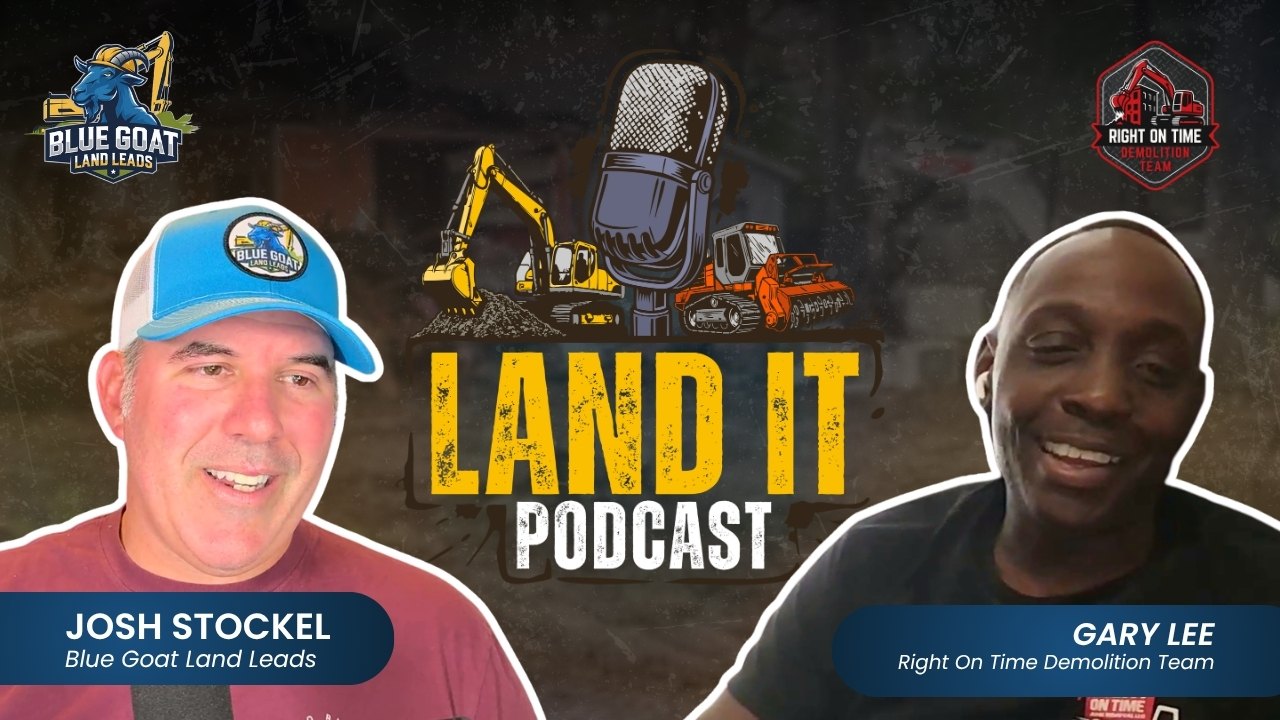
From military service to a removal business
Gary recounts military service, staffing and storm-cleanup work before starting a labor business. Payroll pressure led him to take hauling jobs, then refocus and rebrand around junk removal while bringing demolition experience with him.
More services from the same crew
The company now handles junk removal, demolition, land clearing and dumpster rentals. Gary says he cross-trains workers across removal tasks so crews can shift between junk and demolition jobs.
Play episode 03.
Relationships behind the jobs
Gary discusses repeat work with general contractors and mutual help from other equipment owners, whom he treats as collaborators as well as competitors. He credits reputation and Google visibility with generating inquiries, without presenting a verified attribution breakdown.
Quality and care as the company grows
He describes donating usable items rather than sending everything to a landfill and handling emotionally difficult household cleanouts with care. To preserve service as the team expands, he emphasizes punctuality, courtesy and supervision and says he wants to learn formal quality checks from larger firms.
Pre-demo questions can establish scope before a price
Gary describes planning a list of questions for demolition inquiries before quoting, including whether utilities have been disconnected and whether gas shutoff arrangements have begun. His examples range from pools and decks to houses, foundations and deteriorated mobile homes, so a single generic demolition price would conceal major differences in access and preparation. He also notes that taking a job without the right equipment or crew can consume much of the payment in rentals and temporary labor. The lesson in his account is not a universal permitting checklist: it is to discover the actual conditions and prerequisites before promising a price, then match the job to what the company can responsibly deliver.
See the full conversation.
Why equipment allies matter after the first breakdown
Gary remembers an early excavator job where a hydraulic line was damaged almost immediately after the machine reached the site. A nearby hose repair shop helped, but the larger discussion turns to relationships with other equipment owners. People who might otherwise be labeled competitors lend a hand when someone needs a machine, attachment or extra labor at short notice; Gary recounts driving between locations to help another operator. He treats that mutual support as part of keeping jobs moving when machinery fails or a project needs capabilities one company does not have on hand. It is a practical network built through reciprocal work, not an assertion that every competitor will provide free help.
Look at estimates as well as signed jobs
The interview moves beyond whether an advertisement generated a phone call. Josh suggests recording the amount of each estimate alongside the lead source and location, even when the prospect does not immediately book. Gary connects that information to the types of demolition and the areas he might prefer to pursue. A contractor comparing only closed jobs could miss where larger opportunities are appearing or where inquiries do not match the crew's work. The conversation proposes using that evidence to refine future targeting; it does not provide a verified campaign return, a measured close rate or proof that a particular Houston neighborhood outperforms another.
Ideas to take back to the work
- Hauling work solved an immediate payroll problem and became the business's core service.
- Cross-training lets the crew serve related removal and demolition needs.
- Gary presents better quality-control systems as a growth task, not an already finished process.
Questions from this conversation
What does Right On Time Junk Removal do beyond hauling junk?
Gary mentions demolition, land clearing, dumpster rentals and some renovation-related work.
Why did Gary shift away from staffing?
He says weekly payroll was difficult to fund while restoration clients paid later, whereas hauling brought in work more directly.
How does he plan to maintain service quality while growing?
He checks his crews' work and customer conduct, and says he intends to develop systems and ask larger operators about their quality checks.
What should Gary ask before quoting a demolition job?
He discusses checking practical prerequisites, including utility disconnection and gas-related preparation, before naming a price. His examples also imply that the object being removed and the equipment required change the scope. The episode does not supply a complete local permitting or safety checklist for every demolition project.
Why track demolition estimates that never close?
Josh suggests recording quoted amounts, geography and lead information so the company can see which kinds of opportunities are coming in, not only which jobs sold. Gary says that could help him choose areas or demolition categories to pursue. They discuss a proposed method, not a published attribution report.