
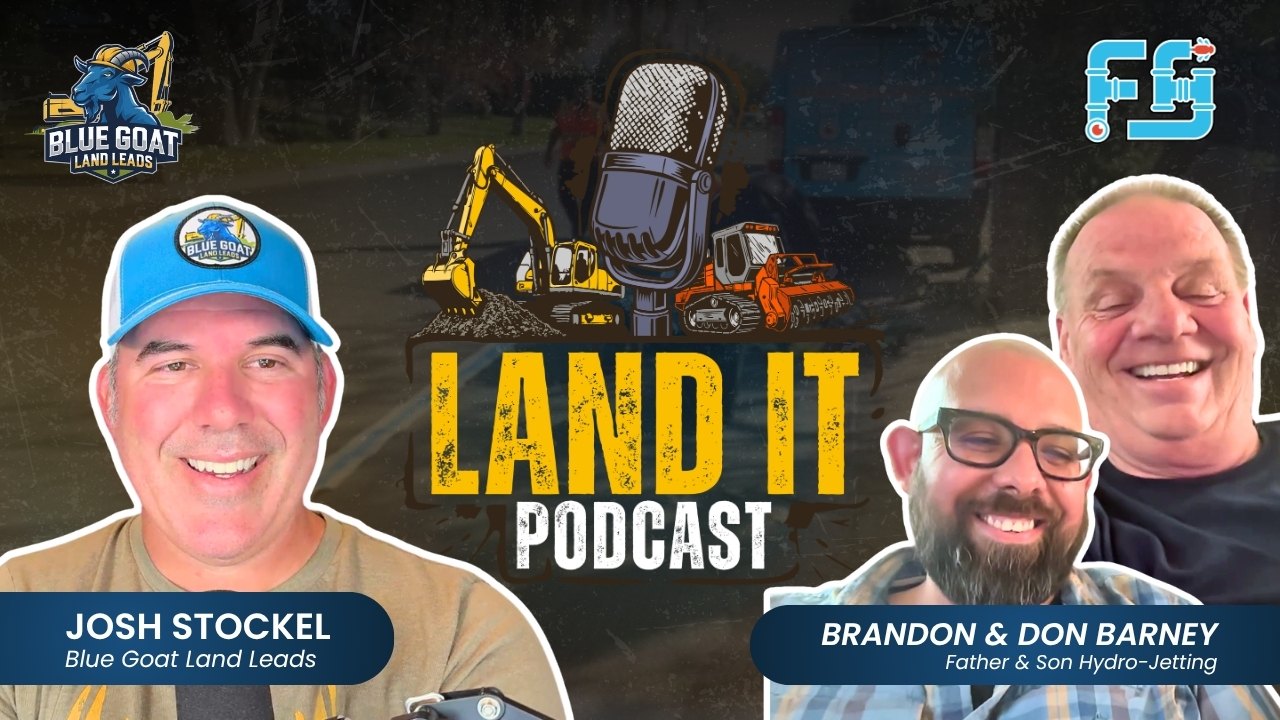
A father-son pivot toward hydro jetting
Don says Brandon proposed starting a business together after Don's long plumbing career. They explain that focusing on jetting and sewer inspections reduces some parts, staffing and training burdens of a broader plumbing operation and gives Brandon a business Don hopes to pass on.
Cleaning and inspecting the whole line
Don contrasts cable work that opens a blockage with jetting intended to clean the pipe. They pair service with narrated camera inspection and favor checking root regrowth before prescribing a fixed annual service interval.
Play episode 04.
Trust before the next invoice
The pair discuss asking for reviews without offering a reward, responding professionally to complaints and explaining findings to clients. Don describes involving an elderly customer's daughter, with permission, to help her use a home-maintenance policy rather than simply selling a replacement.
Profitability through scope and boundaries
They say they track overhead, decide when a follow-up camera visit is practical and keep clear father-son responsibilities. They also describe turning down jobs that cannot be done safely or correctly, rather than accepting every call.
Descaling is a separate decision from jetting
Don and Brandon also discuss cast-iron drain lines whose internal scale changes the pipe's effective shape and can leave water sitting in the line. They describe a descaling machine with cutting chains for that buildup, separate from their explanation of jetting grease and roots. Brandon discusses choosing a lighter machine than an alternative they had considered, while the pair weigh what specialized tools cost against the work available to pay for them. None of this means every old cast-iron line can be restored or avoids replacement. The episode's useful distinction is diagnostic: look at the material and condition through a camera, then consider which cleaning method, if any, addresses the problem found.
See the full conversation.
Training capacity shapes the service the family offers
Don contrasts the extended drain-cleaning training he received early in his career with what he sees as inadequate hands-on training in parts of today's plumbing industry. He worries about technicians selling work they cannot perform and about the difficulty of finding experienced people a new firm can safely insure and supervise. Those are his observations, not a measured claim about every plumbing employer. They help explain why the father and son favor a focused operation instead of quickly assembling a broad plumbing workforce. His experience in the field and Brandon's work on the business side are complementary, but neither replaces the need to know how a service will actually be performed.
A smaller fleet is part of the growth plan
Brandon says his ambition is to serve their Los Angeles area well, not build a nationwide chain. In the interview he imagines a future fleet of roughly five to seven trucks and a team large enough to offer employees benefits and a sustainable place to work. Don connects growth to passing on a business with fair treatment of customers intact. This is an aspiration, not the company's current fleet or a confirmed hiring commitment. It gives the profit discussion an important boundary: lower overhead today is useful only if the company can still invest in the people, equipment and quality needed for the operation they actually want.
Ideas to take back to the work
- Jetting plus camera documentation is their chosen alternative to a quick drain-opening fix.
- A follow-up schedule depends on observed pipe conditions, not a universal interval.
- Their approach to profitability includes overhead awareness and declining unsuitable jobs.
Questions from this conversation
How do the guests distinguish hydro jetting from cabling?
Don says a cable can open a blocked line, while their jetting process aims to clean around the pipe's circumference.
Do they tell every customer to jet the line annually?
No. Don says he prefers a later camera check to see how quickly roots return before suggesting a schedule.
How do Don and Brandon split responsibility?
They say they have separate lanes in the business and redirect questions to the person responsible for that area.
Is descaling the same service as hydro jetting?
No. The guests describe descaling as a separate method for buildup inside cast-iron pipe, using a specialized chain-cutting machine. Their hydro-jetting discussion focuses on cleaning a drain line rather than merely opening a blockage. A camera inspection informs what they see; the conversation does not prescribe either treatment for every line.
Do Don and Brandon want a nationwide plumbing chain?
Brandon says he wants to serve their Los Angeles area and pictures a relatively modest future fleet, not a national rollout. He and Don also discuss building a workplace where technicians can have benefits and want to stay. Those numbers and employment ideas describe a goal, not a verified current company size.