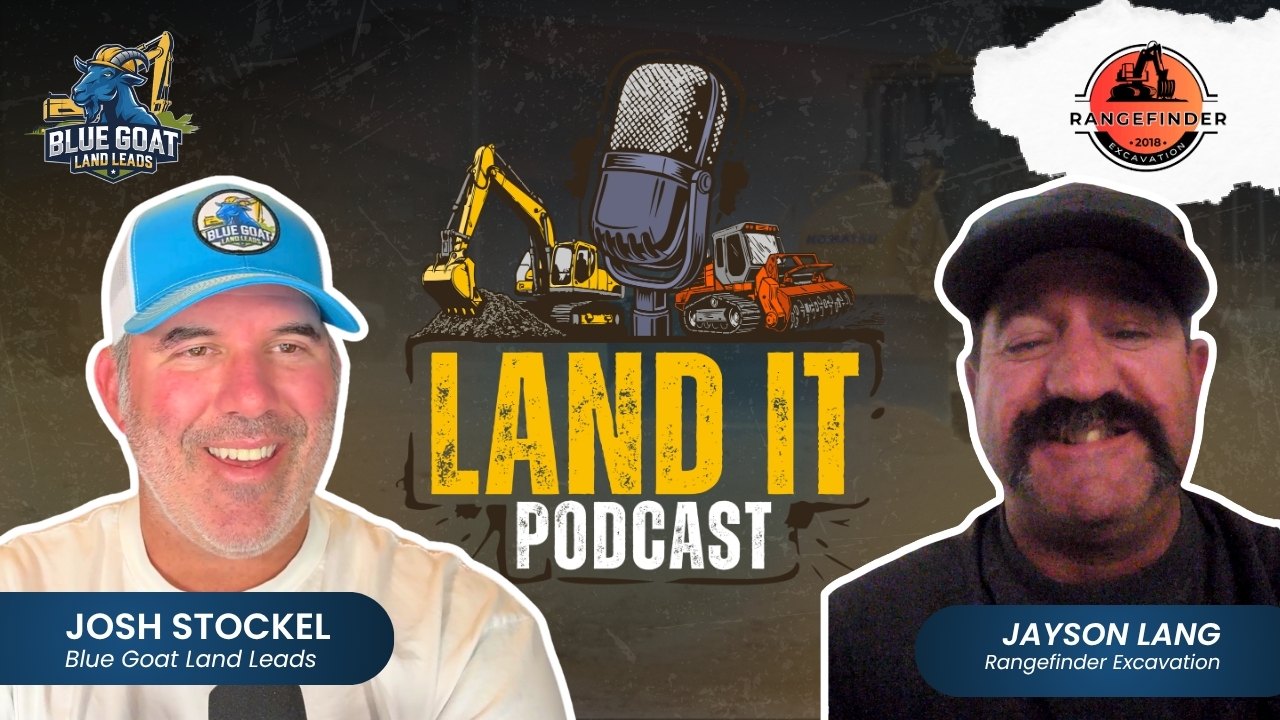
Starting with a dozer and borrowed equipment
Lang describes buying a used dozer on payments and trading access to other owners' water trucks and rollers for work instead of renting them. Early jobs centered on clearing, grubbing and oilfield-related reclamation around Midland, Texas.
Growing without losing owner access
He reports about $5 million in gross revenue the prior year and two crews at the time of recording. Rather than chase size for its own sake, he wants to remain close to jobs and available to customers for direct decisions.
Play episode 02.
Keeping crews and surviving slow periods
Lang prioritizes self-direction and workmanship when hiring, while acknowledging that strong people may eventually start their own firms. He recounts a severe contract collapse during the pandemic and says he resisted bidding below what quality work required.
A difficult site and a durable client relationship
A blow-sand job made hauling and access far harder than expected; Lang's team completed it, and the developer initiated a change-order discussion. He says the job paid its bills but produced no profit, illustrating the cost of unpredictable site conditions.
Where Rangefinder draws the line between self-performed and subcontracted work
Lang describes a present-day mix of clearing and commercial dirt work, including subdivisions, RV parks and man camps. He does not present Rangefinder as a contractor that self-performs every trade a project might require. When customers need concrete or asphalt, he says he uses other companies regularly; he had done asphalt work previously but found it hard to keep that crew busy. This boundary helps explain how a relatively lean operation can remain useful to a developer without carrying permanent labor for every specialty. It is also a different kind of equipment discipline from the early borrowed-truck story: decide what work belongs in the core operation and maintain dependable partners for the rest.
See the full conversation.
An employee's departure becomes a subcontracting relationship
One supervisor Lang trained worked independently enough that Lang could send plans, the site and start information without regularly visiting him. Eventually that worker started his own company. Lang says he continued sending him jobs Rangefinder could not reach, because he trusted the quality of the work and the way it reflected on him when he acted as general contractor. The story complicates the usual retention discussion: developing a capable person can mean losing an employee yet gaining a known trade partner. Lang also notes the former worker later better understood the budget-driven decisions he had questioned as an employee. The episode offers this as one relationship, not a guaranteed staffing strategy.
The obligation behind a bid when contracts disappear
Lang's account of the pandemic downturn is about more than lost volume. He says a substantial book of contracts evaporated within weeks, the crew shrank sharply and he kept working until projects returned. When Josh asks how he persevered through difficult jobs, Lang talks about responsibility to employees and their families as well as to his own household. That perspective helps explain his reluctance to accept work priced too low to support the quality he promises. It does not mean he could preserve every job during the downturn; by his account, he could not. The useful distinction is between caring for a team and pretending that underpriced contracts can sustain it.
Ideas to take back to the work
- Resourceful equipment access helped Lang start with limited capital.
- His positioning is quality work plus direct owner involvement rather than the lowest bid.
- Owner involvement helps customers but makes keeping up with estimates a bottleneck.
Questions from this conversation
How did Rangefinder Excavation get started?
Lang says he began with a used dozer, borrowed or traded for other equipment and took clearing and excavation work.
Why does Lang avoid getting too large?
He wants to manage crews personally and let customers speak directly with someone who can make a decision.
What does he say is his biggest operational struggle?
Balancing field supervision with office work, especially keeping up with bids.
Does Rangefinder perform concrete and asphalt itself?
Lang says the company primarily handles clearing and dirt work and sends concrete and asphalt to contractors it uses regularly. He previously performed asphalt work but found a dedicated asphalt crew difficult to keep busy. The episode does not describe Rangefinder as a self-performing, all-trades contractor.
What happened when a trusted Rangefinder supervisor started his own firm?
Lang says he continued referring work his own crews could not reach to that former employee because he trusted his workmanship. He describes the worker as having learned job management and bidding under him, while the business's budget decisions became clearer to him after becoming an owner himself.