
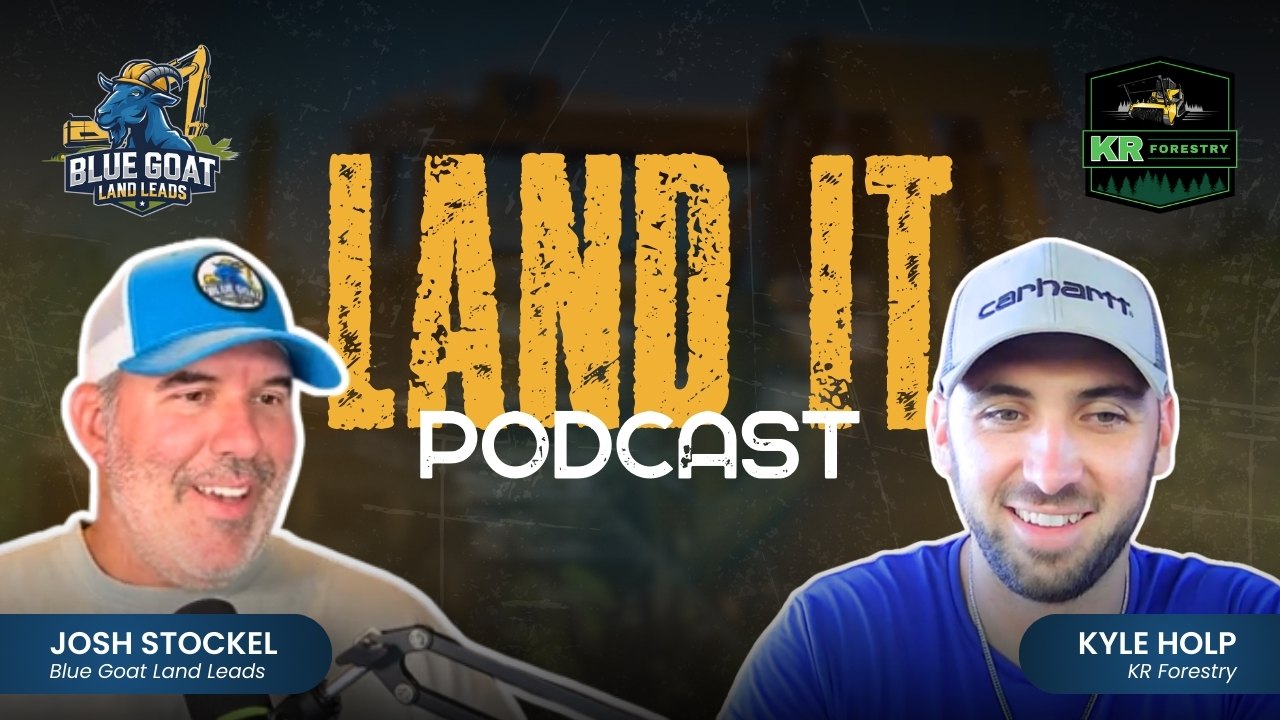
Turning owned equipment into hired work
Holp describes moving from welding and equipment ownership into offering land-clearing services rather than renting the equipment out. At recording time he characterizes the operation as young and still working out its marketing and scaling approach.
The first step into utility work
Most work had been residential, but he describes a utility-clearing opportunity as his first civil job. With little comparable experience, he says he priced it by the day and drew on advice from other contractors.
Play episode 06.
Manage terrain and expectations before mulching
Holp discusses wet ground, rocks and jobsite access as factors that change what he can deliver. He favors explaining likely limits and alternatives, such as excavating a stump rather than grinding it in some cases, before work begins.
Growing beyond the owner-operator bottleneck
Holp says bids, scheduling and fieldwork together leave him near the point of needing help but not yet ready for a full hire. He also argues that a usable, presentable website and brand help prospects judge a young company.
Repairs are a growth cost, not an exception
Holp says several machine repairs landed close together, including tracks and a front plate, making the bill harder to absorb than a series of smaller, spaced-out fixes. He describes working with a nearby mechanic, budgeting time for service and identifying rental options if his skid steer fails while jobs remain booked. That last option is a contingency he has looked into, not a claim that he has already deployed a rental fleet. The discussion gives a young mulching operator a more realistic view of capacity: the schedule depends not only on booked jobs and advertising but also on whether a primary machine can run and what happens when it cannot.
See the full conversation.
The utility opportunity began as a rental inquiry
Holp says a utility contractor contacted him through a Facebook Marketplace advertisement while considering renting equipment for its own employee. The conversation shifted toward having Holp perform the work, with one of the contractor's people on site. Because the assignment was new to him and did not have a fixed acreage target, he offered a day rate for an initial period rather than inventing a precise per-acre bid. He also mentions asking experienced people about municipal and other public-sector opportunities. That sequence is a specific entry point into a first utility-clearing job, not evidence of an established pipeline of public contracts or a repeatable procurement shortcut.
The disc-golf project exposed what a walk-through could not show
A wooded disc-golf-course clearing job sounded straightforward when the client supplied a plan, but Holp says the vegetation was so dense that the interior terrain could not be fully assessed before work. Once inside, he encountered hills and material larger than anticipated, experienced equipment failures and rented a bigger machine. He worked from the customer's layout rather than claiming to have designed the course himself. The example extends his advice about setting expectations: when visibility into a site is poor, the uncertainty belongs in the conversation before promising a smooth schedule. The eventual result was a course he remained interested in, but the transcript does not establish its lasting ranking.
Ideas to take back to the work
- The utility contract is an early expansion example, not evidence of an established utility division.
- Clear expectations about ground conditions help protect both result and customer relationship.
- Holp wants to grow the team so operating equipment becomes a choice rather than an everyday requirement.
Questions from this conversation
Where was most of KR Forestry Mulching's work at the time?
Holp says it was mainly residential work, with a new utility-clearing project emerging.
How did he price his first civil/utility job?
He says he used day pricing because he had not done that kind of job before.
What makes hiring difficult for him?
He says he is nearly too busy to do everything himself but not consistently busy enough to justify another full-time person.
What backup does Holp consider when his skid steer breaks down?
He describes a nearby mechanic, planned repair time and looking into rental companies that could supply a skid steer or machine with a mulching head while his own equipment is down. Those are contingencies he discusses; the interview does not show a standing backup machine in his fleet.
Did Holp design the disc-golf course he cleared?
No. He says the customer had a plan and Holp cleared according to it. The overgrown site hid hilly ground and larger material, which required more work and a bigger rented machine after equipment trouble. It is a jobsite-assessment example, not a claim that he designed the holes.