
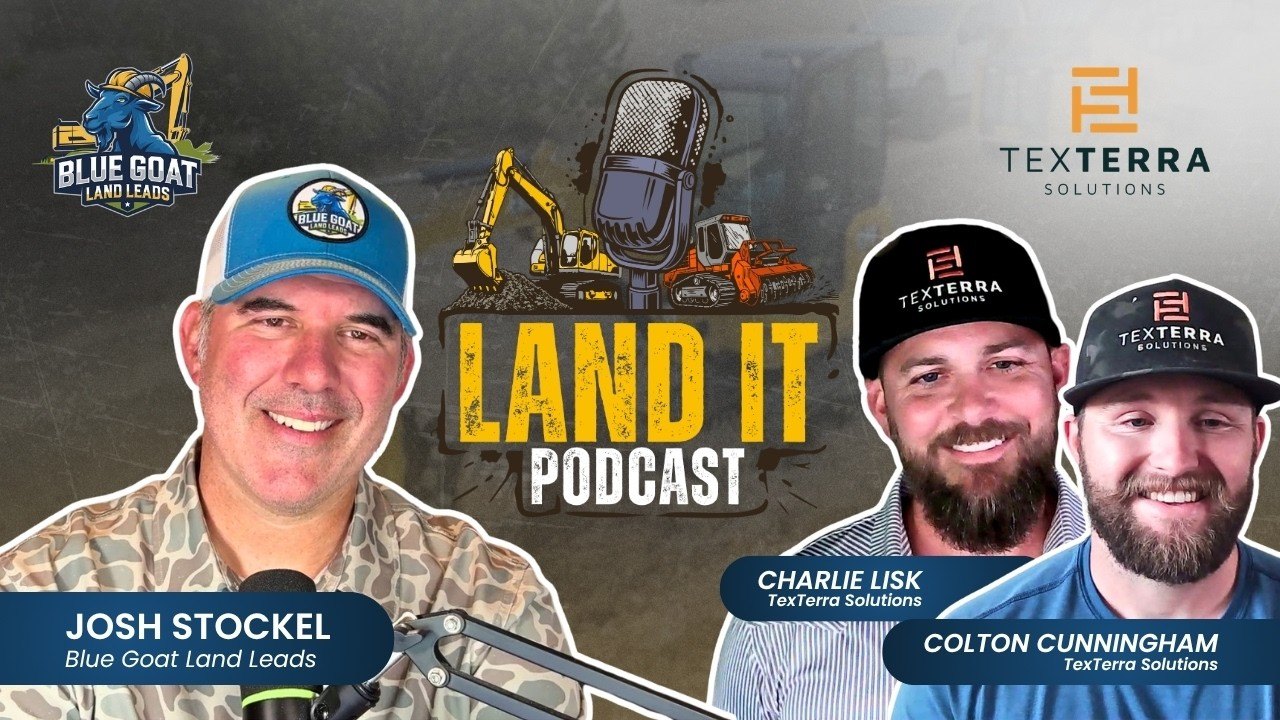
Complementary partners, different responsibilities
Charlie brings a background in technology, strategy and systems; Colton brings field and site-work expertise. They argue that separating those responsibilities makes their partnership more useful than two owners competing for the same work.
Become a builder's site partner
TexTerra describes coordinating multiple exterior scopes for builders rather than only supplying one trade. Clear invoicing, consideration for other crews and leaving the site better organized are part of the service experience they want builders to notice.
Play episode 10.
Change the sales process when the customer mix changes
The team discusses expanding from largely business-to-business work into farm-and-ranch customers by qualifying and following up with prospects more systematically. After a slow period, they added weekly metrics and outbound follow-up, while cautioning against rolling out too many process changes at once.
Use AI and CRM data to support people
Charlie describes AI as a thought partner for procedures and decisions and as a way to reduce office work while keeping investment in field productivity. The conversation also stresses that new leads need a CRM and a response process, not simply more advertising.
Settle ownership and equipment questions before partnership friction
Charlie and Colton did more than divide office and field responsibilities when forming TexTerra. They worked through questions about their respective goals and how a half-and-half services partnership could operate when Charlie supplied the initial capital and still held another full-time job. Charlie describes holding equipment through a separate entity he owned, with the services business able to use it while they built momentum, rather than imposing an early rental charge that would drain the new venture. That arrangement is their particular solution, not a template for every contractor. The broader lesson from their discussion is to address contribution, asset ownership and the vision for the company before a disagreement becomes personal.
See the full conversation.
Different customer types produce different cash-flow rhythms
The builder relationships TexTerra values can take months of contact before a project starts, and payment after a substantial job can involve invoice delays. Colton contrasts that with farm-and-ranch prospects: he aims to inspect the property and return a bid promptly, and describes the relief of collecting payment when a job ends. A pond expansion requiring extensive dirt haul-off illustrates why the timing matters when a contractor has already committed money to production. The company does not describe abandoning custom builders; it treats direct-to-owner work as another kind of opportunity that can help occupy crews and soften the cash-flow gaps between longer builder projects.
Capture site conditions so estimating can improve
For TexTerra, a CRM is more than a place to store names. Charlie describes recording characteristics such as how wooded, hilly or rocky a property was, then comparing the duration quoted with the time the work actually took. Those imperfect but repeatable observations can show whether a particular kind of site consistently runs longer than expected. They also make the pipeline easier to discuss without relying on one person's memory. Charlie argues that useful systems need data from the work itself, not just an owner carrying the answers in his head. That is a practical precursor to any automation: first decide what the team should record after each walk and completed job.
Ideas to take back to the work
- Define who owns field execution and who owns strategy and administration in a partnership.
- Make the full builder experience, including site coordination and invoices, part of the offering.
- Connect lead generation to follow-up systems, and introduce AI-driven changes at a pace the team can absorb.
Questions from this conversation
What does TexTerra mean by becoming a partner instead of a vendor?
It aims to coordinate several outside scopes for a builder, anticipate other crews' needs and reduce the builder's project-management burden.
How did the company respond to a slow period?
It implemented weekly metrics and more structured outbound contact and follow-up, then sought team feedback on the proposed changes.
Why does a CRM matter before increasing ad spend?
The guests say an influx of leads is wasted if there is no consistent place and process to capture, respond to and track those prospects.
How did TexTerra address unequal initial equipment investment in a half-and-half partnership?
Charlie says he initially owned the equipment through a separate entity while he and Colton shared the services business equally. They discussed how that equipment would be available to the new operation without burdening it with an early rental charge. It was a specific arrangement they talked through, not a general recommendation about legal structure.
What field data does TexTerra want to collect for better estimates?
The team discusses rating property conditions, including trees, slope and rock, then tracking how long a job was bid to take against its actual duration. Charlie sees that history as the foundation for learning which conditions change production time and for building a process another employee can use without relying solely on his or Colton's recollection.